The Next Era of Programmable Matter
The Next Era of Programmable Matter
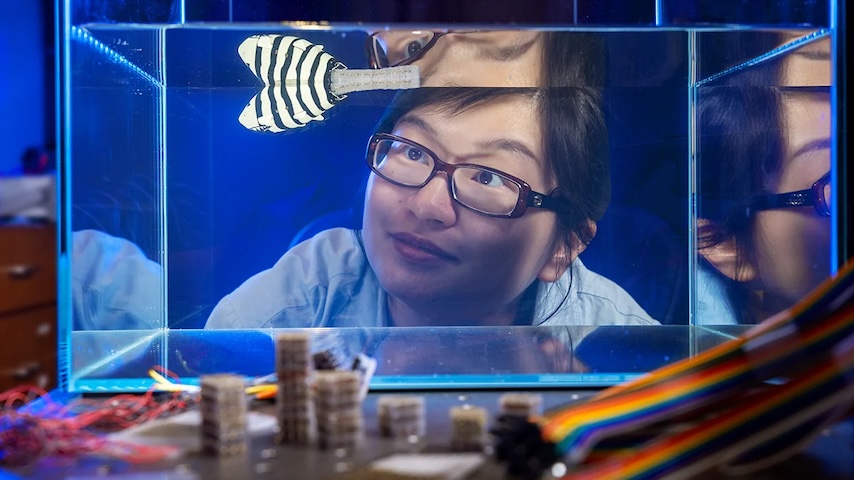
Researchers have unlocked robotic building blocks using electrically heated elements that turn solids to liquids, which allows the material to mimic a wide range of mechanical behaviors.
The internal architecture of material dictates how it behaves, and for decades, scientists have been trying to find a way to design that architecture with precision. A group of researchers at Duke University, led by Xiaoyue Ni, assistant professor in the Department of Mechanical Engineering and Materials Science, has taken a big step toward that goal by enabling programming of phase states in voxelated form.
Controlling where material is solid and where it is fluid allows researchers to mimic a huge range of mechanical behaviors. “By enabling complex phase architecture, we can model very different mechanical behavior,” Ni explained. “It can be foam-like, plastic-like, elastomer-like, or polymer-like.”
The key to this transformation is a liquid metal composite. Researchers infused gallium, which has a melting point just above room temperature, with magnetic iron particles. The loading ratio of the iron particles serves as the tuning knob for the material’s thermal behavior and allows researchers to lock gallium in either a solid or a liquid state at room temperature. Although stable, the material’s phase states can be rewritten. In simple terms, the material function is analogous to a rewritable hard drive for reprogramming mechanical properties.
Reconfigurable materials are not new, but most existing strategies rely on structural transformation to switch between two states. Ni’s group wanted something more fundamental, materials that can reconfigure their properties on demand. “The overarching idea was to create materials such that the material properties, performance, and functionality can be precisely controlled on the fly,” she said.
The team used a combination of a simplified finite element model and a rapid genetic algorithm to explore how different phase arrangements influence behavior. “We leveraged the ability to execute quick iterations with the simplified model to find target properties,” she explained.
.gif "0609_Programmable-Matter_02-(1).gif")
Instead of manually guessing where solid or liquid should be, Ni and her team used inverse design to compute the exact voxel configuration needed for a target performance.
Once programmed, the material holds its state without continuous power and only needs to be cooled to be reprogrammed.
Discover the Benefits of ASME Membership
Preliminary testing demonstrated that a 3D beam could be reconfigured to steer a robotic fish along diverse trajectories while maintaining a constant motor output. “If we wanted the tail to be a straight beam and then change it to a helicoil, we could program the voxels in 3D space instead of physically removing and replacing the beam on the fish,” Ni explained.
Standard practice for cooling is to place the material in a cooling cage. Because the components are modular, large components can be disassembled like blocks, cooled in sections, and then reprogrammed individually and reconnected. The team also is developing alternative cooling methods and has tested a plug-in cooling socket for localized reprogramming. Additionally, Ni said, “The voxels can be designed to maintain a liquid state only under active heating, allowing continuous reprogramming in real time without cooling the material.”
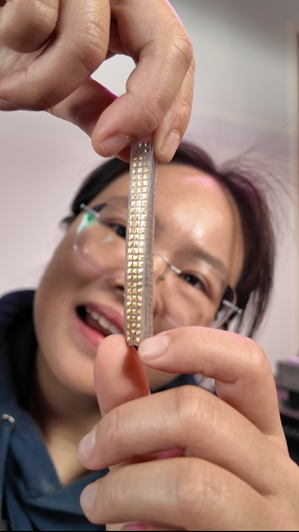 Researcher Yun Bai holds the programmable beam the team used for preliminary testing in an experiment in which the beam was used to steer a robotic fish. Photo: Yun Bai/Duke University
According to Ni, this technology is particularly useful in soft robotics. Today, robots control motion through force or displacement, and there is no way to precisely control materials (the soft bodies themselves). This technology changes the paradigm by opening up more degrees of freedom to enable better agility and dexterity, she said.
The technology also enables mechanical impedance matching. “If you want to match the interface of a device with skin or soft tissue, this technology makes it possible to customize the material so it matches directly to improve signal transmission, enhance interfacial robustness, or reduce the risk of failure,” Ni explained.
More for You: Researchers Develop ‘Super Foam’ That Could Reduce Injuries and Save Lives
Although current work focuses on solid-liquid phase control for tuning mechanical properties, the same phase design framework could be applied to acoustic, optical, or magnetic properties.
The technology also can be used to collect field data.
“Historically, if you wanted to test a design, you had to create multiple samples and test them one by one. Using this technology, you can build one sample and reprogram it for further testing to rapidly gather a huge amount of data that possibly can be used for machine learning (ML),” she explained.
The next stage of research for Ni and her team will move into the complex realm of fluid-structure interaction. They plan to use ML to explore how different stiffness distributions allow structures to harvest energy from their environment.
“This will be difficult to simulate, so it is an exciting field for future study using programmable matter,” she said. “As we learn to kill resisting forces and optimize energy harvesting through material control, we also will be moving the technology closer to commercial reality.”
Judy Murray is an independent writer in Houston.
Controlling where material is solid and where it is fluid allows researchers to mimic a huge range of mechanical behaviors. “By enabling complex phase architecture, we can model very different mechanical behavior,” Ni explained. “It can be foam-like, plastic-like, elastomer-like, or polymer-like.”
The key to this transformation is a liquid metal composite. Researchers infused gallium, which has a melting point just above room temperature, with magnetic iron particles. The loading ratio of the iron particles serves as the tuning knob for the material’s thermal behavior and allows researchers to lock gallium in either a solid or a liquid state at room temperature. Although stable, the material’s phase states can be rewritten. In simple terms, the material function is analogous to a rewritable hard drive for reprogramming mechanical properties.
Beyond structural transformation
Reconfigurable materials are not new, but most existing strategies rely on structural transformation to switch between two states. Ni’s group wanted something more fundamental, materials that can reconfigure their properties on demand. “The overarching idea was to create materials such that the material properties, performance, and functionality can be precisely controlled on the fly,” she said.
The team used a combination of a simplified finite element model and a rapid genetic algorithm to explore how different phase arrangements influence behavior. “We leveraged the ability to execute quick iterations with the simplified model to find target properties,” she explained.
By liquifying specific patterns of cells (purple, left), researchers can program and reprogram solid materials with bespoke mechanical properties. The same column with different configurations behaves quite differently when attached to a simple motor (right). Image: Duke University
Instead of manually guessing where solid or liquid should be, Ni and her team used inverse design to compute the exact voxel configuration needed for a target performance.
Once programmed, the material holds its state without continuous power and only needs to be cooled to be reprogrammed.
Discover the Benefits of ASME Membership
Preliminary testing demonstrated that a 3D beam could be reconfigured to steer a robotic fish along diverse trajectories while maintaining a constant motor output. “If we wanted the tail to be a straight beam and then change it to a helicoil, we could program the voxels in 3D space instead of physically removing and replacing the beam on the fish,” Ni explained.
Standard practice for cooling is to place the material in a cooling cage. Because the components are modular, large components can be disassembled like blocks, cooled in sections, and then reprogrammed individually and reconnected. The team also is developing alternative cooling methods and has tested a plug-in cooling socket for localized reprogramming. Additionally, Ni said, “The voxels can be designed to maintain a liquid state only under active heating, allowing continuous reprogramming in real time without cooling the material.”
Practical uses
Researcher Yun Bai holds the programmable beam the team used for preliminary testing in an experiment in which the beam was used to steer a robotic fish. Photo: Yun Bai/Duke University
According to Ni, this technology is particularly useful in soft robotics. Today, robots control motion through force or displacement, and there is no way to precisely control materials (the soft bodies themselves). This technology changes the paradigm by opening up more degrees of freedom to enable better agility and dexterity, she said.
The technology also enables mechanical impedance matching. “If you want to match the interface of a device with skin or soft tissue, this technology makes it possible to customize the material so it matches directly to improve signal transmission, enhance interfacial robustness, or reduce the risk of failure,” Ni explained.
More for You: Researchers Develop ‘Super Foam’ That Could Reduce Injuries and Save Lives
Although current work focuses on solid-liquid phase control for tuning mechanical properties, the same phase design framework could be applied to acoustic, optical, or magnetic properties.
The technology also can be used to collect field data.
“Historically, if you wanted to test a design, you had to create multiple samples and test them one by one. Using this technology, you can build one sample and reprogram it for further testing to rapidly gather a huge amount of data that possibly can be used for machine learning (ML),” she explained.
What’s next
The next stage of research for Ni and her team will move into the complex realm of fluid-structure interaction. They plan to use ML to explore how different stiffness distributions allow structures to harvest energy from their environment.
“This will be difficult to simulate, so it is an exciting field for future study using programmable matter,” she said. “As we learn to kill resisting forces and optimize energy harvesting through material control, we also will be moving the technology closer to commercial reality.”
Judy Murray is an independent writer in Houston.
Researchers have unlocked robotic building blocks using electrically heated elements that turn solids to liquids, which allows the material to mimic a wide range of mechanical behaviors.

Professional writer, strategist, content developer, owner of Word Source
Related Content


Oct 1, 2026
Engineering the Sounds of Silence

Many of the things that engineers create make a lot of noise. Now there’s a crop of engineers trying to turn the volume down for all of us.


Sep 9, 2026
5 Myths About Borosilicate Glass
SCHOTT's Tina Gallo tackles five myths that may be causing engineers to underestimate borosilicate glass.

Jul 30, 2026
Ion Beams Speed Qualification for Nuclear Materials

By mimicking years of neutron damage in days, ion beam testing could dramatically reduce the time and cost of qualifying materials for advanced nuclear reactors.
Jun 23, 2026
Defects to Boost Strength

New research into the tiniest of metals has revealed that defects can make a nanoscaled object stronger.