An Engineering Landmark in Tractor Innovation
An Engineering Landmark in Tractor Innovation
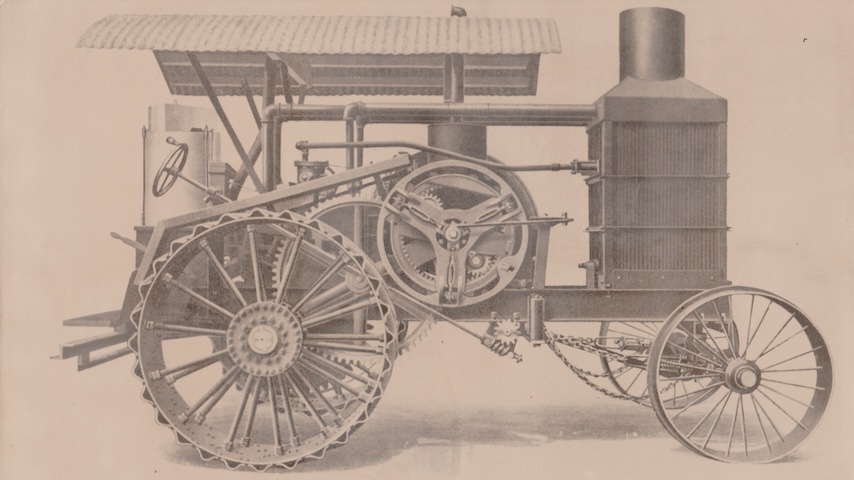
The Hart-Parr Model 3 is the first tractor to be mass produced with an internal combustion engine, earning its designation as a Historical Mechanical Engineering Landmark.
Tractors were one of the driving forces that reshaped American agriculture in the 20th century. Inventors Charles W. Hart and Charles H. Parr motorized a tractor with an internal combustion engine and they were the first to reach mass production with their Model 3 in 1903.
This advancement over steam engines helped farmers safely and economically tend to their wheat fields. The Hart-Parr Model 3 is an ASME Historical Mechanical Engineering Landmark and resides in the National Museum of American History’s collection as the “oldest surviving internal combustion engine tractor in the United States.”
Hart and Parr met during their studies at the University of Wisconsin-Madison and co-presented a thesis in 1896 on a design for a gasoline-powered traction combustion engine, according to the “History of the Charles City Tractor Plant” by the Floyd County Museum. Though they began fabrication in Madison, they ultimately transferred their base of operations in 1901 to Hart’s hometown of Charles City, Iowa.
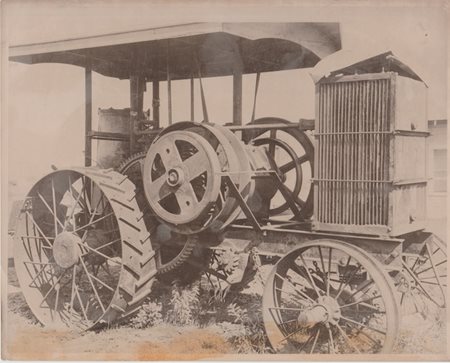 The Hart-Parr Model 3 was the first tractor to be mass produced with an internal combustion engine. Photo: Floyd County Museum
“This rural community offered ample and inexpensive land, transportation from two major railroads, and capital funding from the local bank,” explained Dean Tjaden, Floyd County Museum board president and a former Oliver-White employee.
The Hart-Parr Model 3 was the first tractor to be mass produced with an internal combustion engine. Photo: Floyd County Museum
“This rural community offered ample and inexpensive land, transportation from two major railroads, and capital funding from the local bank,” explained Dean Tjaden, Floyd County Museum board president and a former Oliver-White employee.
Within a year, the fledging company made its first tractor model and then iterated the design twice. Model 3 became the first internal combustion tractor to be mass produced, with a run of 13 tractors in 1903.
This milestone is noteworthy as Hart-Parr’s founding predates International Harvester’s formation from a 1902 merger as well as the sale of its first Friction Drive tractor in 1906. The 1903 Model 3 is also 15 years ahead of John Deere’s 1918 acquisition of the Waterloo Gas Engine Company. Its original founder and fellow Iowan John Froelich was the first to fashion a 1-cylinder internal combustion traction motor in 1890, though the company didn’t achieve commercial success until 1914.
Another Historic Landmark: A Landmark in Typecasting
“We like to think of Parr as the nuts-and-bolts partner, especially since he stayed with the company his whole life. Hart had wider interests, leaving his position in 1917 and moving into the oil refinery business,” Tjaden noted.
“It’s also significant that tractor as an equipment term is attributed to Hart-Parr sales manager W.H. Williams in 1907,” added Meghan Ward, director of the Floyd County Museum. He used it as a portmanteau in promotional materials, and it quickly became industry standard.
The Hart-Parr tractor was a direct competitor to steam engines. This technology had already been paired with threshers by the Civil War, decades after steam began to power ships and trains at the turn of the 18th century. But on farms, a steam machine surrounded by flammable plants in hot weather presented a genuine risk to operate.
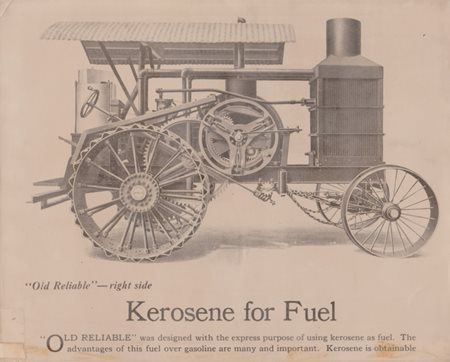 This Hart-Parr ad touts the benefit of kerosene, which was a safe, cheap fuel compared to steam. Photo: Floyd County Museum
“Steam tractors were really cumbersome in the fields. They weren’t necessarily more cost effective than horses because they required a trained crew to run. It also took 1 to 2 hours to secure water and burn fuel to heat it up,” Tjaden explained. “Furthermore, steam was a fire hazard because sparks were common and parts were hot enough to cause burns. Overheating could even result in a flash steam boil.”
This Hart-Parr ad touts the benefit of kerosene, which was a safe, cheap fuel compared to steam. Photo: Floyd County Museum
“Steam tractors were really cumbersome in the fields. They weren’t necessarily more cost effective than horses because they required a trained crew to run. It also took 1 to 2 hours to secure water and burn fuel to heat it up,” Tjaden explained. “Furthermore, steam was a fire hazard because sparks were common and parts were hot enough to cause burns. Overheating could even result in a flash steam boil.”
You Might Also Enjoy: Engineering Chattanooga’s 130-Year-Old Incline Railway
Gasoline and kerosene, which was an inexpensive byproduct, also had an economic advantage over steam. It’s another reason why Hart and Parr took inspiration from gas traction engines used for chopping wood and pumping water already present on farms.
“Hart and Parr revolutionized the act of farming because they converted a stationary concept into a moving machine for field use,” Ward stressed. “Not only did they leverage portable power to make equipment more accessible to everyday farmers, but they cut down on the need for labor. It was a real advancement to have a single person operating the tractor.”
Though Iowa is today’s leading state for corn production, wheat was a staple before the 1900s. The Hart-Parr was specifically designed for the heavy tillage needed for wheatland, which differs from row crops. Accordingly, the robust machine topped 14,000 pounds. Dubbed “Old Reliable” during its 1907–1918 production, the Hart-Parr Model 3 used a 2-cylinder engine with a “unique hit-and-miss firing cycle that produced 30 horsepower at the belt and 18 at the drawbar,” according to the Smithsonian.
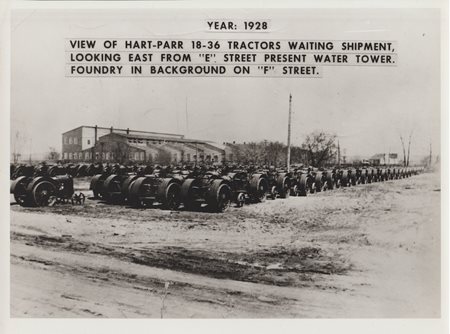 A total of 3,798 Model 3 units were built, shown outside of the Charles City, Iowa factory. Photo: Floyd County Museum
The design also introduced a number of engineering accomplishments, as detailed in the ASME’s brochure released for the 1996 landmark designation. These included a plow gear that could transmit more torque, a valve-in-head design with overhead cam, a gravity fuel feed system and double carburetor with water injection for kerosene-only operation, a low-tension magneto ignition system, a forced feed lubrication system, and multiple wheels compatible with different soils.
A total of 3,798 Model 3 units were built, shown outside of the Charles City, Iowa factory. Photo: Floyd County Museum
The design also introduced a number of engineering accomplishments, as detailed in the ASME’s brochure released for the 1996 landmark designation. These included a plow gear that could transmit more torque, a valve-in-head design with overhead cam, a gravity fuel feed system and double carburetor with water injection for kerosene-only operation, a low-tension magneto ignition system, a forced feed lubrication system, and multiple wheels compatible with different soils.
Hart-Parr eventually merged into the Oliver Farm Equipment Company in 1929. The Charles City plant remained in operation through numerous subsequent acquisitions, including ownership by the White Motor Corp. and Allis Corp., until it closed in 1993. It was the largest employer in Charles City for 92 years, with a peak workforce of 3,000, as noted in the “History of the Charles City Tractor Plant” (additional plant history is available in the Oliver Archives).
“What is notable 125 years later about Hart-Parr is that it represents another step in farming automation,” Tjaden explained. “They understood the importance of supplementing labor force with mechanical might.”
Jennie M. Morton is an engineering and construction writer based in Iowa.
This advancement over steam engines helped farmers safely and economically tend to their wheat fields. The Hart-Parr Model 3 is an ASME Historical Mechanical Engineering Landmark and resides in the National Museum of American History’s collection as the “oldest surviving internal combustion engine tractor in the United States.”
Company origins
Hart and Parr met during their studies at the University of Wisconsin-Madison and co-presented a thesis in 1896 on a design for a gasoline-powered traction combustion engine, according to the “History of the Charles City Tractor Plant” by the Floyd County Museum. Though they began fabrication in Madison, they ultimately transferred their base of operations in 1901 to Hart’s hometown of Charles City, Iowa.
The Hart-Parr Model 3 was the first tractor to be mass produced with an internal combustion engine. Photo: Floyd County Museum
Within a year, the fledging company made its first tractor model and then iterated the design twice. Model 3 became the first internal combustion tractor to be mass produced, with a run of 13 tractors in 1903.
This milestone is noteworthy as Hart-Parr’s founding predates International Harvester’s formation from a 1902 merger as well as the sale of its first Friction Drive tractor in 1906. The 1903 Model 3 is also 15 years ahead of John Deere’s 1918 acquisition of the Waterloo Gas Engine Company. Its original founder and fellow Iowan John Froelich was the first to fashion a 1-cylinder internal combustion traction motor in 1890, though the company didn’t achieve commercial success until 1914.
Another Historic Landmark: A Landmark in Typecasting
“We like to think of Parr as the nuts-and-bolts partner, especially since he stayed with the company his whole life. Hart had wider interests, leaving his position in 1917 and moving into the oil refinery business,” Tjaden noted.
“It’s also significant that tractor as an equipment term is attributed to Hart-Parr sales manager W.H. Williams in 1907,” added Meghan Ward, director of the Floyd County Museum. He used it as a portmanteau in promotional materials, and it quickly became industry standard.
Solving an explosive problem
The Hart-Parr tractor was a direct competitor to steam engines. This technology had already been paired with threshers by the Civil War, decades after steam began to power ships and trains at the turn of the 18th century. But on farms, a steam machine surrounded by flammable plants in hot weather presented a genuine risk to operate.
This Hart-Parr ad touts the benefit of kerosene, which was a safe, cheap fuel compared to steam. Photo: Floyd County Museum
You Might Also Enjoy: Engineering Chattanooga’s 130-Year-Old Incline Railway
Gasoline and kerosene, which was an inexpensive byproduct, also had an economic advantage over steam. It’s another reason why Hart and Parr took inspiration from gas traction engines used for chopping wood and pumping water already present on farms.
“Hart and Parr revolutionized the act of farming because they converted a stationary concept into a moving machine for field use,” Ward stressed. “Not only did they leverage portable power to make equipment more accessible to everyday farmers, but they cut down on the need for labor. It was a real advancement to have a single person operating the tractor.”
A lasting legacy
Though Iowa is today’s leading state for corn production, wheat was a staple before the 1900s. The Hart-Parr was specifically designed for the heavy tillage needed for wheatland, which differs from row crops. Accordingly, the robust machine topped 14,000 pounds. Dubbed “Old Reliable” during its 1907–1918 production, the Hart-Parr Model 3 used a 2-cylinder engine with a “unique hit-and-miss firing cycle that produced 30 horsepower at the belt and 18 at the drawbar,” according to the Smithsonian.
A total of 3,798 Model 3 units were built, shown outside of the Charles City, Iowa factory. Photo: Floyd County Museum
Hart-Parr eventually merged into the Oliver Farm Equipment Company in 1929. The Charles City plant remained in operation through numerous subsequent acquisitions, including ownership by the White Motor Corp. and Allis Corp., until it closed in 1993. It was the largest employer in Charles City for 92 years, with a peak workforce of 3,000, as noted in the “History of the Charles City Tractor Plant” (additional plant history is available in the Oliver Archives).
“What is notable 125 years later about Hart-Parr is that it represents another step in farming automation,” Tjaden explained. “They understood the importance of supplementing labor force with mechanical might.”
Jennie M. Morton is an engineering and construction writer based in Iowa.
The Hart-Parr Model 3 is the first tractor to be mass produced with an internal combustion engine, earning its designation as a Historical Mechanical Engineering Landmark.

Freelance writer based in Iowa
Related Content


Oct 1, 2026
Engineering the Sounds of Silence

Many of the things that engineers create make a lot of noise. Now there’s a crop of engineers trying to turn the volume down for all of us.
Sep 3, 2026
5 Mechanical Innovations to Watch in 2026

From adaptive safety belts to biomechanical drug delivery, these recent mechanical engineering breakthroughs are setting the stage for the future.

Sep 1, 2026
The Next Robotics Frontier


The robotics industry often focuses on scale, automation, and valuations. But a quieter group of founders is instead asking what robotics have overlooked as they innovate with compassion in mind.

Aug 28, 2026
Quiz: The Origins of Automation
Automation’s roots run back to mechanization and the first factories, and it has been compounding ever since. See how well you know that path.