Smarter Models for Faster Fusion Research
Smarter Models for Faster Fusion Research
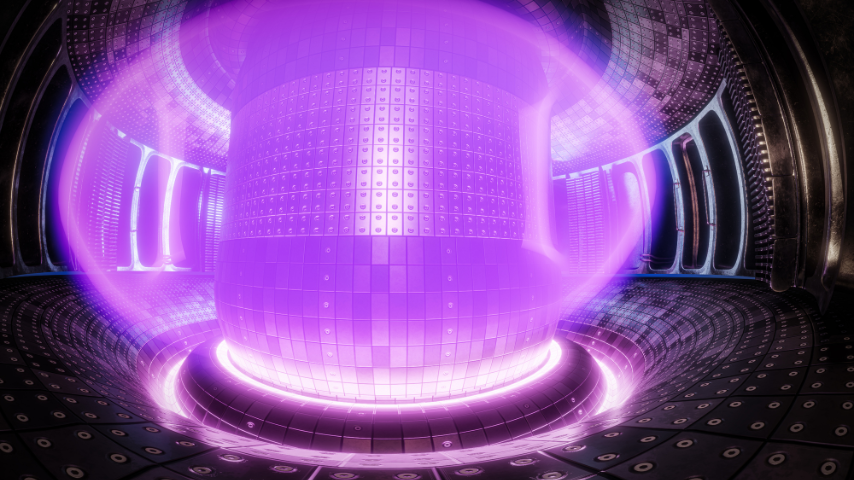
A Virginia Tech researcher is developing reduced models that could help fusion researchers make faster predictions with less computing power.
Nuclear fusion experiments are, to oversimplify matters, complex undertakings. They require enormous amounts of energy, mathematics, engineering finesse, and money. Any hope of a future powered by fusion energy depends not only on continued experimentation, but also on the development of effective computational models.
Good algorithms can help researchers design, interpret, and optimize experiments more quickly and efficiently, and they may eventually serve as essential design tools and control mechanisms for operating and maintaining fusion systems.
But fusion is so complex that high-fidelity models can themselves require enormous amounts of computation, time, and money. In fact, solving a single problem using a detailed simulation of a fusion device on one of today’s fastest supercomputers can take days or even weeks, consuming enormous computational resources.
“In an ideal world, we would simulate every particle in the plasma and its interactions directly,” said Ionut Farcas, a professor of mathematics at Virginia Tech. “The problem is that a fusion plasma can contain on the order of 100 quintillion particles, making such a direct simulation computationally infeasible on any existing computer.”
To put it simply, if we want models to help us design and control fusion reactors, they have to provide predictions on much shorter timescales. What Farcas has done is create algorithms that discard extraneous information to run faster. And not just a little bit faster. His reduced models can produce predictions in seconds or milliseconds where other simulations would take days or weeks.
 Farcas likens these methods to GPS. “It doesn’t give you all the detail; it doesn’t give you all the trees, all the rocks, or every feature in the landscape,” he said. “It just tells you to go this way and you will get to your destination. Very roughly speaking, this is like a reduced model. You sacrifice some of the detail, but you can still get an answer that you are satisfied with.”
So, which details can be safely neglected in modeling a fusion plasma? The answer depends on what the model is intended to accomplish. “We want algorithms that can identify for themselves which features are important for a particular task,” Farcas said. “Many of the algorithms we develop have built-in mechanisms for neglecting details that are unimportant according to a precise mathematical criterion. If the goal is to understand a physical process in detail, those features may be essential and cannot simply be ignored. But if the goal is to predict the average behavior of the system, many of the smallest-scale details may have little influence on the quantity we care about.”
The broader aspiration is to construct models that can adapt as new information becomes available. For example, if an unusual event occurs in a part of the plasma behavior that was not represented in the training data, the model could use the new observations to refine its predictions of similar events in the future.
“Very loosely speaking, it is like the immune system learning to recognize a new threat,” Farcas said. In an adaptive modeling framework, prediction errors and new observations can be used to refine the model, rather than requiring it to be rebuilt entirely from scratch.
Creating such a model with AI methods is a different beast from many of the AI-assisted success stories of recent years. Whereas typical AI models are informed by massive amounts of high-quality data, models for fusion must often draw from smaller but highly informative datasets.
There may be scenarios in which greater resolution than a reduced model can provide is required, even though a high-fidelity simulation cannot be completed on the necessary timescale without a supercomputer. But that does not mean fusion researchers have to throw up their hands or turn entirely to more expensive and time-consuming alternatives.
Farcas is now working on an alternative paradigm called multi-fidelity modeling. “We almost always have several sources of information for a problem,” he said. Where one model may be limited, another may provide complementary information. “The question is: instead of using just one of them, can I use them all together for decision-making? And this is the idea of multi-fidelity modeling, which I think is a very promising way to approach fusion and other complex applications.”
Though his target is fusion, Farcas’ algorithms are likely to be useful for any application with tremendous complexity, including rocketry, weather patterns, and more. He is currently working with a colleague at Virginia Tech on a geophysical problem involving mantle convection. Their goal is to develop efficient computational models for inferring parameters that govern mantle flow, such as plate coupling strength, stress exponents, and yield strength. “It is a completely different application from rockets or fusion, but many of the underlying computational challenges, and therefore many of the algorithms, are essentially the same.”
As for fusion, the algorithms are not yet being used to operate fusion facilities. But Farcas has demonstrated that it is possible to apply them to real-world problems using limited amounts of data. He is now partnering with various startups in the hope of solving specific problems they face.
His efforts may soon enable cheap and plentiful computational exploration of fusion systems, an important step toward the goal of a future with cheap and plentiful fusion energy.
Michael Abrams is a technology writer in Westfield, N.J.
Good algorithms can help researchers design, interpret, and optimize experiments more quickly and efficiently, and they may eventually serve as essential design tools and control mechanisms for operating and maintaining fusion systems.
But fusion is so complex that high-fidelity models can themselves require enormous amounts of computation, time, and money. In fact, solving a single problem using a detailed simulation of a fusion device on one of today’s fastest supercomputers can take days or even weeks, consuming enormous computational resources.
“In an ideal world, we would simulate every particle in the plasma and its interactions directly,” said Ionut Farcas, a professor of mathematics at Virginia Tech. “The problem is that a fusion plasma can contain on the order of 100 quintillion particles, making such a direct simulation computationally infeasible on any existing computer.”
Faster answers from leaner models
To put it simply, if we want models to help us design and control fusion reactors, they have to provide predictions on much shorter timescales. What Farcas has done is create algorithms that discard extraneous information to run faster. And not just a little bit faster. His reduced models can produce predictions in seconds or milliseconds where other simulations would take days or weeks.
Engineering a Cleaner Energy Future
In the latest episode of ASME TechCast, Caroline DeWitte, co-founder and COO of Oklo, discusses the opportunities and challenges shaping the future of advanced nuclear energy.
So, which details can be safely neglected in modeling a fusion plasma? The answer depends on what the model is intended to accomplish. “We want algorithms that can identify for themselves which features are important for a particular task,” Farcas said. “Many of the algorithms we develop have built-in mechanisms for neglecting details that are unimportant according to a precise mathematical criterion. If the goal is to understand a physical process in detail, those features may be essential and cannot simply be ignored. But if the goal is to predict the average behavior of the system, many of the smallest-scale details may have little influence on the quantity we care about.”
The broader aspiration is to construct models that can adapt as new information becomes available. For example, if an unusual event occurs in a part of the plasma behavior that was not represented in the training data, the model could use the new observations to refine its predictions of similar events in the future.
“Very loosely speaking, it is like the immune system learning to recognize a new threat,” Farcas said. In an adaptive modeling framework, prediction errors and new observations can be used to refine the model, rather than requiring it to be rebuilt entirely from scratch.
Combining models for better predictions
Creating such a model with AI methods is a different beast from many of the AI-assisted success stories of recent years. Whereas typical AI models are informed by massive amounts of high-quality data, models for fusion must often draw from smaller but highly informative datasets. There may be scenarios in which greater resolution than a reduced model can provide is required, even though a high-fidelity simulation cannot be completed on the necessary timescale without a supercomputer. But that does not mean fusion researchers have to throw up their hands or turn entirely to more expensive and time-consuming alternatives.
Farcas is now working on an alternative paradigm called multi-fidelity modeling. “We almost always have several sources of information for a problem,” he said. Where one model may be limited, another may provide complementary information. “The question is: instead of using just one of them, can I use them all together for decision-making? And this is the idea of multi-fidelity modeling, which I think is a very promising way to approach fusion and other complex applications.”
Applications beyond fusion
Though his target is fusion, Farcas’ algorithms are likely to be useful for any application with tremendous complexity, including rocketry, weather patterns, and more. He is currently working with a colleague at Virginia Tech on a geophysical problem involving mantle convection. Their goal is to develop efficient computational models for inferring parameters that govern mantle flow, such as plate coupling strength, stress exponents, and yield strength. “It is a completely different application from rockets or fusion, but many of the underlying computational challenges, and therefore many of the algorithms, are essentially the same.”As for fusion, the algorithms are not yet being used to operate fusion facilities. But Farcas has demonstrated that it is possible to apply them to real-world problems using limited amounts of data. He is now partnering with various startups in the hope of solving specific problems they face.
His efforts may soon enable cheap and plentiful computational exploration of fusion systems, an important step toward the goal of a future with cheap and plentiful fusion energy.
Michael Abrams is a technology writer in Westfield, N.J.


As renewable energy gains momentum, oil and natural gas continue to remain primary global energy sources. This collection delves into latest digital trends enabling breakthroughs in energy transformation.