STEM Talent Shortage Could Cost U.S. $1.4 Trillion
STEM Talent Shortage Could Cost U.S. $1.4 Trillion
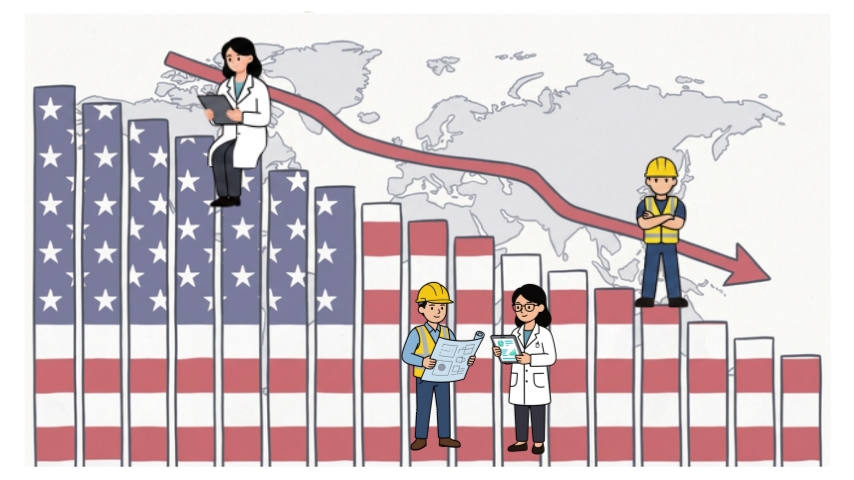
A new report warns that the U.S. could lose $1.4 trillion in economic output over the next decade if STEM talent fails to keep pace with demand.
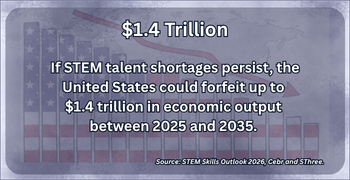
A new report warns that the United States could lose up to $1.4 trillion in economic output over the next decade if the supply of STEM talent fails to keep pace with demand. Commissioned by the Centre for Economics and Business Research and Specialist Staffing Group, “STEM Skills Outlook 2026” examines how shortages in engineering and other technological fields could affect major economies.
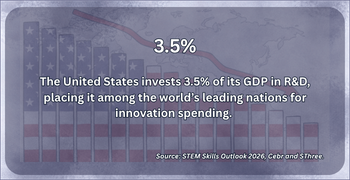
Among 42 economies, the global outlook concludes the U.S. is facing the largest potential loss of STEM-driven output. At the same time, the report identified significant strengths within the U.S. innovation ecosystem. Research and development expenditures account for 3.5 percent of U.S. GDP, placing the country among the world’s leading investors in innovation.
Despite those strengths, the U.S. ranked 18th overall in the report’s STEM Skills Index and fourth among G7 nations. Researchers found particular weaknesses in foundational STEM education and engineering talent development, while noting that STEM accounted for just 11 percent of total U.S. output—a below-average share that places the nation behind 33 other economies.
The U.S. also has a broad non-STEM base made up of financial services, real estate, and other manufacturing activities. That economic diversity helps explain why the country’s STEM contribution appears smaller as a share of total output, even as the absolute value of its STEM economy remains significant.
 “The United States faces the largest projected loss of STEM-driven economic output because it combines exceptionally high demand for technical talent with increasing pressure on the pipeline supplying that talent,” explained Stefan Hirniak, the U.S. president of Specialist Staffing Group. The STEM Skills Outlook assesses the exposure of global economies to supply shortages and structural risks in science, technology, engineering, and mathematics.
A composite index, constructed to measure risk, estimates that the U.S. could see more than $1 trillion in economic output at risk between 2025 and 2035 if current workforce pressures continue, he added.
One of the most important dynamics shaping that outlook is growing global competition for highly skilled STEM workers. The U.S. has historically benefited from its ability to attract international students, researchers, and technical professionals, particularly in engineering and advanced scientific fields. “But as competition for STEM talent intensifies globally, access to that talent is becoming increasingly strategic,” Hirniak explained.
Growth in domestic STEM graduates has also slowed relative to rising industry demand, creating additional pressure on the workforce pipeline. For an economy where STEM capability underpins a significant share of innovation, productivity, and industrial output, the consequences are projected to be substantial, he concluded.
“The U.S. needs more engineering and technical talent across the entire STEM workforce pipeline, particularly in areas tied to engineering, computing, mathematics, and advanced digital capability,” Hirniak said. “As industries become more dependent on AI, automation, and data-driven systems, demand for workers with technical expertise continues to accelerate across the economy.”
 Employers are not only looking for highly specialized STEM professionals, he added. They also need workers who can operate in increasingly technology-intensive environments. “That includes engineering expertise, computing and data capabilities, and broader technical skills needed to support advanced industrial and digital systems,” he said.
Businesses are investing heavily in technology, infrastructure, and innovation, but the return on those investments depends on having people with the technical expertise to implement and operate them effectively. “As demand for these capabilities expands across multiple sectors simultaneously, competition for STEM talent is becoming increasingly intense,” Hirniak noted.
The slower growth in STEM graduates reflects a widening gap between the pace of economic and technological change and the capacity of education systems to respond. The report shows that while demand for STEM capability is rising rapidly, graduate growth in key STEM disciplines has not kept pace.
The index “also points to broader structural pressures, including demographic shifts and aging workforces, which are contributing to tighter labor markets across many advanced economies,” Hirniak explained. As a result, employers are facing increasing competition for STEM talent while the pipeline of new graduates is growing more slowly.
Taken together, these trends are creating a growing imbalance between the skills economies need and the number of workers entering the market with those capabilities.
Digital transformation is driving the biggest increase in demand for technical skills, particularly as AI, automation, and data-driven technologies become more embedded across the economy. “Demand is no longer confined to traditional technology companies,” Hirniak explained. “Industries including manufacturing, infrastructure, and energy are becoming more technology-intensive and competing for many of the same engineering and technical skill sets.”
 As businesses invest more heavily in advanced technologies, the need for workers with expertise in engineering, computing, and other STEM disciplines continues to accelerate. The result is a much broader and more competitive market for technical talent, where STEM capability is becoming increasingly central to productivity, innovation, and long-term economic growth.
Sustained investment means recognizing that STEM capability is now central to long-term economic growth and competitiveness. “The STEM Skills Index shows that demand for technical expertise is accelerating faster than many workforce pipelines can respond, placing increasing pressure on education systems, employers, and labor markets,” Hirniak explained.
The report also points out notable strengths within the U.S. innovation ecosystem. Research and development expenditures account for 3.5 percent of U.S. GDP, placing the country among the world’s leading investors in innovation. The analysis suggests that maintaining that advantage will require ensuring a sufficient supply of engineers, scientists, and technical professionals to translate research investments into economic growth.
That investment includes strengthening STEM education and technical training, while also expanding workforce development and reskilling opportunities as industries become more technology driven. Access to global talent is equally important. Competition for highly skilled engineers, researchers, and technical professionals is intensifying internationally, and countries that can continue to attract that talent will be better positioned to support innovation, productivity, and future growth.
Added Hirniak, “Ultimately, economies that invest consistently in STEM talent development will be better equipped to keep pace with rising demand for technical expertise.”
Cathy Cecere is membership content program manager.
Among 42 economies, the global outlook concludes the U.S. is facing the largest potential loss of STEM-driven output. At the same time, the report identified significant strengths within the U.S. innovation ecosystem. Research and development expenditures account for 3.5 percent of U.S. GDP, placing the country among the world’s leading investors in innovation.
Despite those strengths, the U.S. ranked 18th overall in the report’s STEM Skills Index and fourth among G7 nations. Researchers found particular weaknesses in foundational STEM education and engineering talent development, while noting that STEM accounted for just 11 percent of total U.S. output—a below-average share that places the nation behind 33 other economies.
U.S. faces the largest projected STEM output loss
The U.S. also has a broad non-STEM base made up of financial services, real estate, and other manufacturing activities. That economic diversity helps explain why the country’s STEM contribution appears smaller as a share of total output, even as the absolute value of its STEM economy remains significant.
A composite index, constructed to measure risk, estimates that the U.S. could see more than $1 trillion in economic output at risk between 2025 and 2035 if current workforce pressures continue, he added.
One of the most important dynamics shaping that outlook is growing global competition for highly skilled STEM workers. The U.S. has historically benefited from its ability to attract international students, researchers, and technical professionals, particularly in engineering and advanced scientific fields. “But as competition for STEM talent intensifies globally, access to that talent is becoming increasingly strategic,” Hirniak explained.
Growth in domestic STEM graduates has also slowed relative to rising industry demand, creating additional pressure on the workforce pipeline. For an economy where STEM capability underpins a significant share of innovation, productivity, and industrial output, the consequences are projected to be substantial, he concluded.
The STEM skills the U.S. needs most
“The U.S. needs more engineering and technical talent across the entire STEM workforce pipeline, particularly in areas tied to engineering, computing, mathematics, and advanced digital capability,” Hirniak said. “As industries become more dependent on AI, automation, and data-driven systems, demand for workers with technical expertise continues to accelerate across the economy.”
Businesses are investing heavily in technology, infrastructure, and innovation, but the return on those investments depends on having people with the technical expertise to implement and operate them effectively. “As demand for these capabilities expands across multiple sectors simultaneously, competition for STEM talent is becoming increasingly intense,” Hirniak noted.
The slower growth in STEM graduates reflects a widening gap between the pace of economic and technological change and the capacity of education systems to respond. The report shows that while demand for STEM capability is rising rapidly, graduate growth in key STEM disciplines has not kept pace.
The index “also points to broader structural pressures, including demographic shifts and aging workforces, which are contributing to tighter labor markets across many advanced economies,” Hirniak explained. As a result, employers are facing increasing competition for STEM talent while the pipeline of new graduates is growing more slowly.
Taken together, these trends are creating a growing imbalance between the skills economies need and the number of workers entering the market with those capabilities.
Where demand for technical skills is rising
Digital transformation is driving the biggest increase in demand for technical skills, particularly as AI, automation, and data-driven technologies become more embedded across the economy. “Demand is no longer confined to traditional technology companies,” Hirniak explained. “Industries including manufacturing, infrastructure, and energy are becoming more technology-intensive and competing for many of the same engineering and technical skill sets.”
Sustained investment means recognizing that STEM capability is now central to long-term economic growth and competitiveness. “The STEM Skills Index shows that demand for technical expertise is accelerating faster than many workforce pipelines can respond, placing increasing pressure on education systems, employers, and labor markets,” Hirniak explained.
The report also points out notable strengths within the U.S. innovation ecosystem. Research and development expenditures account for 3.5 percent of U.S. GDP, placing the country among the world’s leading investors in innovation. The analysis suggests that maintaining that advantage will require ensuring a sufficient supply of engineers, scientists, and technical professionals to translate research investments into economic growth.

That investment includes strengthening STEM education and technical training, while also expanding workforce development and reskilling opportunities as industries become more technology driven. Access to global talent is equally important. Competition for highly skilled engineers, researchers, and technical professionals is intensifying internationally, and countries that can continue to attract that talent will be better positioned to support innovation, productivity, and future growth.
Added Hirniak, “Ultimately, economies that invest consistently in STEM talent development will be better equipped to keep pace with rising demand for technical expertise.”
Cathy Cecere is membership content program manager.


Learning is a lifelong journey. Explore our growing collection of free learning resources and articles.