Kirigami-Inspired Material Changes Color When Stretched
Kirigami-Inspired Material Changes Color When Stretched
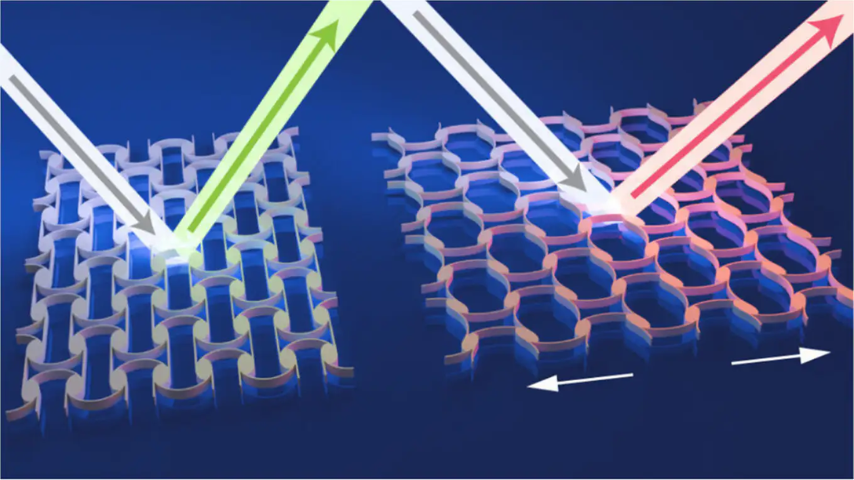
A metamaterial can reflect different colors of light depending on how it is stretched, with potential uses in augmented-reality glasses and compact lidar systems.
Taking cues from the Japanese art of kirigami, scientists at the University of Amsterdam have developed a new kind of material that can change the color of the light it reflects simply by being stretched. Like a piece of paper transformed through cuts and folds, the material reshapes itself under tension—except at a scale thousands of times smaller than a human hair. The flexible, shimmering surface shifts color from green to yellow to red as it is pulled. The findings were published in ACS Photonics.
Kirigami, a close relative of the better-known origami, allows paper to move and bend in ways that would otherwise be impossible. Those principles turned out to be a powerful source of inspiration for physicists working at the intersection of mechanics and optics. “It started with conversations between colleagues working in different fields,” said Jorik van de Groep, group leader of the 2D nanophotonics lab at the University of Amsterdam. “One of my colleagues studies mechanical metamaterials—materials whose behavior is engineered through smartly placed cuts. I work on optical metamaterials, or metasurfaces. At some point, we asked ourselves whether we could combine these two worlds.”
You Might Also Like: The Remarkable Engineering of Shark Skeletons
The resulting metamaterial is a thin silicon membrane patterned with nanoscale structures that both deform and interact strongly with light. Unlike conventional materials that use pigments or dyes to absorb certain wavelengths, this new material gets its color from structure alone. The effect relies on structural color, a phenomenon common in nature. The radiant blue of a butterfly wing or the metallic green of certain beetles comes not from chemistry, but from nanoscale architectures that selectively reflect specific wavelengths of light.
In the new design, the material consists of an array of tiny silicon elements arranged in a precise pattern. When the membrane is stretched, these elements rotate and shift relative to one another. That change in spacing alters how light scattered from each element interferes with light from its neighbors, causing a different color to be reflected. “The spacing between the particles is absolutely crucial,” van de Groep explained. “By mechanically changing that spacing, you directly tune which wavelength of light is reflected.”
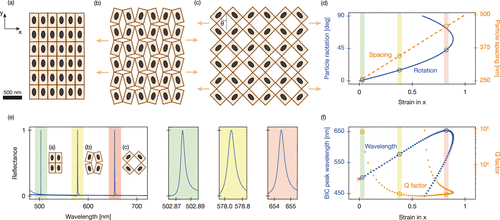 Carefully placed cuts in the kirigami substrate enable engineered mechanical deformations, and thereby unusually large strain and internal rotations. Image: van de Groep et al., ACS Photonics, 2025.
Getting to that point, however, was far from straightforward. One of the biggest challenges was silicon itself. At everyday scales, silicon is brittle and prone to cracking—not an obvious choice for something meant to stretch. Early ideas involved placing silicon nanoparticles on a flexible substrate, but the substrate introduced its own mechanical and optical complications. “The real breakthrough,” van de Groep said, “was realizing that we didn’t need a substrate at all.”
Instead, the researchers designed the silicon membrane to be multifunctional. The same nanoscale patterning that governs how the material deforms also determines how it interacts with light. Tiny, pre-curved bridges between patterned regions allow the membrane to stretch without breaking, while leaving the optical response largely intact. “By nanopatterning a thin silicon membrane, we made it simultaneously a mechanical metamaterial and an optical metasurface,” van de Groep said. “That combination is really the novelty here.”
Discover the Benefits of ASME Membership
So far, the work has been demonstrated in detailed simulations. The next step is turning theory into reality. The team is now working to fabricate an actual flexible metasurface in a cleanroom facility, producing silicon membranes only about 100 nanometers thick. “At these length scales, fabrication is the real challenge,” van de Groep said. “You have to pattern extremely fine features without having the membrane collapse or tear.” The researchers are drawing on techniques from MEMS, where microscopic mechanical structures routinely move billions of times without failure.
 Jorik van de Groep leads the 2D Nanophotonics group. Image: Van de Groep Lab
If successful, the implications could be wide-ranging. Because the material reflects color without absorbing light, it could enable ultra-low-power reflective displays, similar to e-readers but capable of full color. Stretch-tunable structural color could also be used in sensors, where small mechanical deformations caused by temperature, pressure, or chemical exposure produce a visible color change. More broadly, the work points toward a future of adaptive, reconfigurable optics—lightweight optical components that change their function on demand.
Jorik van de Groep leads the 2D Nanophotonics group. Image: Van de Groep Lab
If successful, the implications could be wide-ranging. Because the material reflects color without absorbing light, it could enable ultra-low-power reflective displays, similar to e-readers but capable of full color. Stretch-tunable structural color could also be used in sensors, where small mechanical deformations caused by temperature, pressure, or chemical exposure produce a visible color change. More broadly, the work points toward a future of adaptive, reconfigurable optics—lightweight optical components that change their function on demand.
The researchers are already thinking beyond simple color tuning. “This is just the beginning,” van de Groep said. Future designs could respond differently depending on how and where they are stretched, enabling devices that not only change color but also steer light or adjust their focal length. Such multifunctional optical elements are attractive for applications ranging from augmented-reality glasses to compact lidar systems in autonomous vehicles.
For now, the focus is on building the first real, working samples and exploring how far the kirigami concept can be pushed at the nanoscale. “Once you realize you can control light by motion rather than chemistry, an entire design space opens up,” van de Groep said. “We’re only just starting to explore it.”
Annemarie Mannion is a technology writer in Chicago.
Kirigami, a close relative of the better-known origami, allows paper to move and bend in ways that would otherwise be impossible. Those principles turned out to be a powerful source of inspiration for physicists working at the intersection of mechanics and optics. “It started with conversations between colleagues working in different fields,” said Jorik van de Groep, group leader of the 2D nanophotonics lab at the University of Amsterdam. “One of my colleagues studies mechanical metamaterials—materials whose behavior is engineered through smartly placed cuts. I work on optical metamaterials, or metasurfaces. At some point, we asked ourselves whether we could combine these two worlds.”
You Might Also Like: The Remarkable Engineering of Shark Skeletons
The resulting metamaterial is a thin silicon membrane patterned with nanoscale structures that both deform and interact strongly with light. Unlike conventional materials that use pigments or dyes to absorb certain wavelengths, this new material gets its color from structure alone. The effect relies on structural color, a phenomenon common in nature. The radiant blue of a butterfly wing or the metallic green of certain beetles comes not from chemistry, but from nanoscale architectures that selectively reflect specific wavelengths of light.
In the new design, the material consists of an array of tiny silicon elements arranged in a precise pattern. When the membrane is stretched, these elements rotate and shift relative to one another. That change in spacing alters how light scattered from each element interferes with light from its neighbors, causing a different color to be reflected. “The spacing between the particles is absolutely crucial,” van de Groep explained. “By mechanically changing that spacing, you directly tune which wavelength of light is reflected.”
Carefully placed cuts in the kirigami substrate enable engineered mechanical deformations, and thereby unusually large strain and internal rotations. Image: van de Groep et al., ACS Photonics, 2025.
Getting to that point, however, was far from straightforward. One of the biggest challenges was silicon itself. At everyday scales, silicon is brittle and prone to cracking—not an obvious choice for something meant to stretch. Early ideas involved placing silicon nanoparticles on a flexible substrate, but the substrate introduced its own mechanical and optical complications. “The real breakthrough,” van de Groep said, “was realizing that we didn’t need a substrate at all.”
Instead, the researchers designed the silicon membrane to be multifunctional. The same nanoscale patterning that governs how the material deforms also determines how it interacts with light. Tiny, pre-curved bridges between patterned regions allow the membrane to stretch without breaking, while leaving the optical response largely intact. “By nanopatterning a thin silicon membrane, we made it simultaneously a mechanical metamaterial and an optical metasurface,” van de Groep said. “That combination is really the novelty here.”
Discover the Benefits of ASME Membership
So far, the work has been demonstrated in detailed simulations. The next step is turning theory into reality. The team is now working to fabricate an actual flexible metasurface in a cleanroom facility, producing silicon membranes only about 100 nanometers thick. “At these length scales, fabrication is the real challenge,” van de Groep said. “You have to pattern extremely fine features without having the membrane collapse or tear.” The researchers are drawing on techniques from MEMS, where microscopic mechanical structures routinely move billions of times without failure.
Jorik van de Groep leads the 2D Nanophotonics group. Image: Van de Groep Lab
The researchers are already thinking beyond simple color tuning. “This is just the beginning,” van de Groep said. Future designs could respond differently depending on how and where they are stretched, enabling devices that not only change color but also steer light or adjust their focal length. Such multifunctional optical elements are attractive for applications ranging from augmented-reality glasses to compact lidar systems in autonomous vehicles.
For now, the focus is on building the first real, working samples and exploring how far the kirigami concept can be pushed at the nanoscale. “Once you realize you can control light by motion rather than chemistry, an entire design space opens up,” van de Groep said. “We’re only just starting to explore it.”
Annemarie Mannion is a technology writer in Chicago.
A metamaterial can reflect different colors of light depending on how it is stretched, with potential uses in augmented-reality glasses and compact lidar systems.

Freelance writer based in Chicago
Related Content


Mar 13, 2026
Quiz: Engineering March Madness

From sneaker friction to rim stress, see what you know about the science and engineering behind the basketball game.


Mar 9, 2026
Robots That Work With Us: How Cobots Are Changing Manufacturing
In this TechCast episode, ASME speaks with Christine Bush of Schneider Electric about how cobots are being deployed in modern manufacturing environments.


Mar 5, 2026
Supporting Fusion Energy at its Turning Point


Mar 4, 2026
Workforce Blog: Inclusive Leadership Drives Tomorrow’s Workforce
Growing a future-focused, powerful engineering workforce requires authenticity and inclusivity.