Hair-Thin Fiber Microphone Could Help Prevent Power Grid Outages
Hair-Thin Fiber Microphone Could Help Prevent Power Grid Outages

Built from a fiber no thicker than a human hair, the microphone detects ultrasonic signals that could provide early warning of transformer faults.
Early signs of transformer failure that can lead to power outages may soon meet their match, as scientists have developed tiny silica microphones capable of detecting faults while withstanding temperatures up to 1,000 °C inside high-voltage transformers.
Xiaobei Zhang led the researchers in Optoelectronics & Optical Engineering with Qi Zhang, professor at the School of Communication and Information Engineering at Shanghai University. They published their new paper in the journal Optics Express, announcing the development in February.
“Our research, led by Professor Xiaobei, is a national key project that's funded by the Chinese version of the NSF. It’s led by the demand from the power grid system that we need a sensor that can be utilized or implemented in the partial environment that is the power grid system,” Zhang said.
Zhang said there is plenty of electromagnetic interference and that traditional sensors cannot be used, so there’s high motivation to create a sensor with high sensitivity and temperature resistance that can still perform well in “harsh conditions.”
“That’s why we want to utilize the fiber optic sensors, which are the size of a hair, and tiny, and we can insert them into the power grid system without any interference to these working conditions,” he said. They were seeking to create a solution that allowed for predictable performance, he added, and they succeeded.
It has to be able to get really hot. It has to be really small. And it has to be able to detect ultrasonic frequencies far beyond the range of human hearing, allowing it to identify changes in power grid systems much earlier than existing technologies. These were the challenges the researchers faced, Zhang shared.
“Our innovation is that we want to create a sensor that has a high, ultra-wide frequency bandwidth as well as high sensitivity. For the traditional sensors, there is a trade-off between the working bandwidth, which is like the ear of the human,” Zhang said.
More For You: A Cooler Data Center
To maintain the ultra-hot, ultra-wide frequency, he said, they needed to have a very high sensitivity to capture very small sounds emitted from the transformer.
The solution was an all-silica fiber microphone capable of detecting the tiny acoustic signatures produced by electrical discharges, sensitive to frequencies from 40 kHz to 1.6 MHz, integrated within a fiber just 125 microns in diameter. Traditional microphones have much bigger containers to house the technology. Zhang shared they experimented with additives and also subtractives to create an “ultra-fast laser to tune the structures of the silica with micro-sized accuracy.” In addition, he said creating packaging for the sensor that wasn’t too fragile was a challenge.
The microphone isn’t as simple as listening and detecting sound. Instead, it detects light in what the paper calls the “photoelastic effect.” This is used to detect vibrations altering a light’s refractive index.
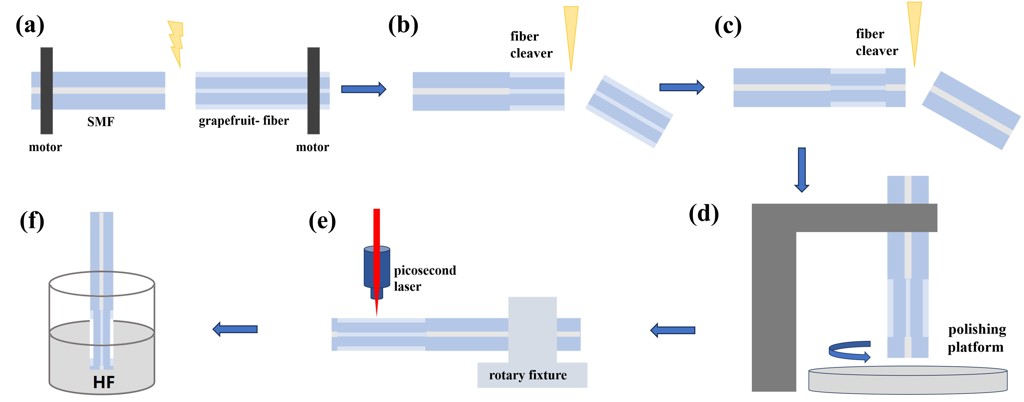 This six-step fabrication process uses picosecond laser irradiation followed by chemical etching to create the all-fiber microphone’s microscopic internal structure. Image: Xiaobei Zhang, Shanghai University
According to the research release, the team developed a sound-sensing design that uses a vibration-sensitive membrane and an internal glass micro-beam suspended inside a single-mode optical fiber. Together, the components form a Fabry-Pérot interferometer capable of detecting extremely small vibrations, including those produced by electrical discharges. The researchers used “picosecond laser-induced chemical etching” to sculpt the suspended structure within the hair-thin fiber. The technique enables the creation of highly precise micro- and nanostructures.
The researchers are open about how many times the research didn’t work out before finding the perfect formula. “We failed a lot of times…and [decided] why not try to make a sensor that is made only of the specialty fibers, and then we have continued to optimize the fabrication process…it took us almost two years to accomplish this structure and these experimental results you have seen,” Zhang said.
Discover the Benefits of ASME Membership
As with many determined researchers, it seems the work is never done. Now they are turning their sights to the meta material, which manipulates the acoustic waves based on human design structures, Zhang said. “We want to include the meta material into the package of the optical fiber sensors. So in one way, it can enhance the robustness of the sensor, and in the other way, by manipulating the acoustic wave, it can amplify the acoustic wave, and so we can continue to amplify the sensitivity of the sensor.”
Though it will be years and many additional steps before the tiny microphone detects early failures in power grid systems, the researchers are on their way to potentially sounding the alarm in a major way.
Alexandra Frost is an independent writer and content strategist in Cincinnati.
Xiaobei Zhang led the researchers in Optoelectronics & Optical Engineering with Qi Zhang, professor at the School of Communication and Information Engineering at Shanghai University. They published their new paper in the journal Optics Express, announcing the development in February.
“Our research, led by Professor Xiaobei, is a national key project that's funded by the Chinese version of the NSF. It’s led by the demand from the power grid system that we need a sensor that can be utilized or implemented in the partial environment that is the power grid system,” Zhang said.
Zhang said there is plenty of electromagnetic interference and that traditional sensors cannot be used, so there’s high motivation to create a sensor with high sensitivity and temperature resistance that can still perform well in “harsh conditions.”
“That’s why we want to utilize the fiber optic sensors, which are the size of a hair, and tiny, and we can insert them into the power grid system without any interference to these working conditions,” he said. They were seeking to create a solution that allowed for predictable performance, he added, and they succeeded.
The challenge
It has to be able to get really hot. It has to be really small. And it has to be able to detect ultrasonic frequencies far beyond the range of human hearing, allowing it to identify changes in power grid systems much earlier than existing technologies. These were the challenges the researchers faced, Zhang shared.
“Our innovation is that we want to create a sensor that has a high, ultra-wide frequency bandwidth as well as high sensitivity. For the traditional sensors, there is a trade-off between the working bandwidth, which is like the ear of the human,” Zhang said.
More For You: A Cooler Data Center
To maintain the ultra-hot, ultra-wide frequency, he said, they needed to have a very high sensitivity to capture very small sounds emitted from the transformer.
The solution was an all-silica fiber microphone capable of detecting the tiny acoustic signatures produced by electrical discharges, sensitive to frequencies from 40 kHz to 1.6 MHz, integrated within a fiber just 125 microns in diameter. Traditional microphones have much bigger containers to house the technology. Zhang shared they experimented with additives and also subtractives to create an “ultra-fast laser to tune the structures of the silica with micro-sized accuracy.” In addition, he said creating packaging for the sensor that wasn’t too fragile was a challenge.
Listening for warning signs inside transformers
The microphone isn’t as simple as listening and detecting sound. Instead, it detects light in what the paper calls the “photoelastic effect.” This is used to detect vibrations altering a light’s refractive index.
This six-step fabrication process uses picosecond laser irradiation followed by chemical etching to create the all-fiber microphone’s microscopic internal structure. Image: Xiaobei Zhang, Shanghai University
According to the research release, the team developed a sound-sensing design that uses a vibration-sensitive membrane and an internal glass micro-beam suspended inside a single-mode optical fiber. Together, the components form a Fabry-Pérot interferometer capable of detecting extremely small vibrations, including those produced by electrical discharges. The researchers used “picosecond laser-induced chemical etching” to sculpt the suspended structure within the hair-thin fiber. The technique enables the creation of highly precise micro- and nanostructures.
If at first you don’t succeed
The researchers are open about how many times the research didn’t work out before finding the perfect formula. “We failed a lot of times…and [decided] why not try to make a sensor that is made only of the specialty fibers, and then we have continued to optimize the fabrication process…it took us almost two years to accomplish this structure and these experimental results you have seen,” Zhang said.
Discover the Benefits of ASME Membership
As with many determined researchers, it seems the work is never done. Now they are turning their sights to the meta material, which manipulates the acoustic waves based on human design structures, Zhang said. “We want to include the meta material into the package of the optical fiber sensors. So in one way, it can enhance the robustness of the sensor, and in the other way, by manipulating the acoustic wave, it can amplify the acoustic wave, and so we can continue to amplify the sensitivity of the sensor.”
Though it will be years and many additional steps before the tiny microphone detects early failures in power grid systems, the researchers are on their way to potentially sounding the alarm in a major way.
Alexandra Frost is an independent writer and content strategist in Cincinnati.
Built from a fiber no thicker than a human hair, the microphone detects ultrasonic signals that could provide early warning of transformer faults.

Journalist in Cincinnati
Related Content


Jul 7, 2026
Retaining Ring Types and Selection
Learn how Smalley approaches retaining ring selection in this sponsored white paper, from internal and external ring configurations to material and manufacturing considerations.

Jul 6, 2026
250 Years of Innovation



Jul 2, 2026
Quiz: Engineering the American Revolution
Engineering ingenuity played a big part during the American Revolution. In honor of the U.S.’s 250th, test your knowledge about such solutions with this ASME quiz.

Jun 30, 2026
Engineering Chattanooga’s 130-Year-Old Incline Railway

Chattanooga’s Lookout Mountain Incline Railway, a funicular and ASME mechanical engineering landmark, has carried riders up a 72.7 percent grade for 130 years.