A Tattoo that Harvests Biomechanical Energy
A Tattoo that Harvests Biomechanical Energy
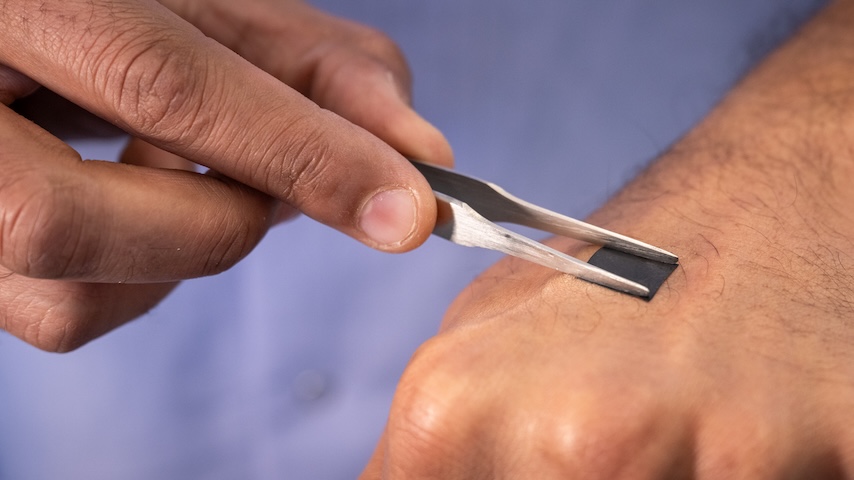
Monitoring ECG and EMG signals without adhesive, hardwiring, or batteries is possible thanks to a newly engineered e-tattoo.
What if patients could wear a biosensing monitor that’s featherlight and powered by their own motion? Thanks to microfabrication techniques with nanomaterials, researchers at Boise State University have delivered a new breakthrough for electronic tattoos (e-tattoos). The device’s unique architecture marries three functions into a single platform: energy harvesting through biomechanical movement, skin conformity without adhesives, and electrocardiogram (ECG) and electromyography (EMG) signal detection.
“The end result was that we improved reliability, enhanced durability, and gained more function from a single e-tattoo,” explained David Estrada of the Micron School of Materials Science and Engineering at Boise State University. The team’s findings were published in Advanced Science.
“E-tattoo is a broad term that encompasses many wearables that conform to the skin due to the substrate’s stretchable nature,” explained Ajay Pratap, lead researcher and doctoral student. “Since they are noninvasive, e-tattoos are suitable for health monitoring.”
Despite the advances in miniaturization, combining the right mix of structural materials and technology into an e-tattoo is an ongoing area of research. Pratap’s multidisciplinary team drew from its expertise in electrical and computer engineering, chemistry, and biomedical engineering to achieve the e-tattoo’s three capabilities: electrospun nanofibers, energy harvesting, and health monitoring.
The base of this multifunctional e-tattoo is made from poly(vinyl butyral‑co‑vinyl alcohol‑co‑vinyl acetate) (PVBVA) fibers. It is produced through electrospinning, which creates an electrical field to pull thin strands of fibers from a jet of resin. They deposit onto a collector surface where they form a cohesive yet non-woven mat.
You Might Also Enjoy: Tattoo-Like Sensor Could Save Lives
“We chose PVBVA because it is hydrophobic and does not dissolve in water but alcohol,” Pratap said. “The polymer is then coated with a titanium carbide (Ti₃C₂Tx) MXene. MXenes are a newer family of 2D materials with electrical conductivity.”
PVBVA is a more sustainable approach compared to fluorinated chains like Teflon or fluorocarbons, which are detrimental to the environment, Estrada continued. “There are no rare earth metals either. Additionally, the base’s manufacturing technique is scalable because you can customize the dimensions of the electrospun PVBVA mat. The MXene materials are also brush coated rather than screen printed,” he said.
“The triboelectric effect is that recognizable phenomena if you have ever shuffled your feet against carpet and then shocked a sibling,” Estrada explained. “This static electricity is when electrons are ripped off a surface and then the charge is transferred to another surface by completing the circuit. We accomplish this through biomechanical motion.”
 From left, David Estrada, professor of materials science and engineering, and Ajay Pratap, lead researcher and doctoral student, created a new architecture for e-tattoos by electrospinning a polymer and coating it with an MXene compound. Photo: Priscilla Grover, Boise State University
The energy is stored in rectifier circuits that convert AC to DC output in order to power the sensors. This overcomes a key hurdle with e-tattoos—integrating a TENG and a skin-conformable substrate without increasing bulkiness or sacrificing performance.
From left, David Estrada, professor of materials science and engineering, and Ajay Pratap, lead researcher and doctoral student, created a new architecture for e-tattoos by electrospinning a polymer and coating it with an MXene compound. Photo: Priscilla Grover, Boise State University
The energy is stored in rectifier circuits that convert AC to DC output in order to power the sensors. This overcomes a key hurdle with e-tattoos—integrating a TENG and a skin-conformable substrate without increasing bulkiness or sacrificing performance.
“Motion is captured where the e-tattoo is placed, though it doesn’t need to be large like exercise,” Pratap clarified. “Our tests demonstrated it successfully captured energy when worn on the neck, fingers, biceps, leg, and palm.”
ECG and electromyography (EMG) signals are just the first biosensors the team tested since they are vital to clinical diagnostics. Estrada anticipates there is great potential to expand on general health monitoring in future work, such as electroretinogram (ERG). It’s also possible e-tattoos could be included as part of a multimodal system, such as gait monitoring. Beyond humans, e-tattoos could even be used for robotic applications and structural health monitoring.
“The main takeaway is that we’re just scratching the surface of which material combinations to use,” Pratap stressed. “We employed one form of MXene, but it’s a whole class with many unique structures to continue exploring.”
Jennie Morton is an engineering and construction writer based in Iowa.
“The end result was that we improved reliability, enhanced durability, and gained more function from a single e-tattoo,” explained David Estrada of the Micron School of Materials Science and Engineering at Boise State University. The team’s findings were published in Advanced Science.
E-Tattoo fundamentals
E-tattoos are removable electronic monitors that are worn directly on the skin. While their name references temporary rub-on tattoos, the “e” can also represent “epidermal.” These devices are an alternative to medical-grade monitors that rely on gels or adhesives. Unobtrusive and flexible, they also stand in contrast to consumer wearables like Fitbit and Apple Watch that house sensors inside a rigid casing.“E-tattoo is a broad term that encompasses many wearables that conform to the skin due to the substrate’s stretchable nature,” explained Ajay Pratap, lead researcher and doctoral student. “Since they are noninvasive, e-tattoos are suitable for health monitoring.”
Despite the advances in miniaturization, combining the right mix of structural materials and technology into an e-tattoo is an ongoing area of research. Pratap’s multidisciplinary team drew from its expertise in electrical and computer engineering, chemistry, and biomedical engineering to achieve the e-tattoo’s three capabilities: electrospun nanofibers, energy harvesting, and health monitoring.
Electrospun nanofibers
Previous designs for e-tattoos used materials like graphene and semiconducting silk nanofibers (SNFs). But their performance can be undermined by the simple presence of sweat. They can also exhibit poor mechanical durability, struggling to twist along with human motion.The base of this multifunctional e-tattoo is made from poly(vinyl butyral‑co‑vinyl alcohol‑co‑vinyl acetate) (PVBVA) fibers. It is produced through electrospinning, which creates an electrical field to pull thin strands of fibers from a jet of resin. They deposit onto a collector surface where they form a cohesive yet non-woven mat.
You Might Also Enjoy: Tattoo-Like Sensor Could Save Lives
“We chose PVBVA because it is hydrophobic and does not dissolve in water but alcohol,” Pratap said. “The polymer is then coated with a titanium carbide (Ti₃C₂Tx) MXene. MXenes are a newer family of 2D materials with electrical conductivity.”
PVBVA is a more sustainable approach compared to fluorinated chains like Teflon or fluorocarbons, which are detrimental to the environment, Estrada continued. “There are no rare earth metals either. Additionally, the base’s manufacturing technique is scalable because you can customize the dimensions of the electrospun PVBVA mat. The MXene materials are also brush coated rather than screen printed,” he said.
Energy harvesting
Continuous power is supplied by the wearer’s own movement using a triboelectric nanogenerator (TENG), which directs the energy to a parallel-plate capacitor.“The triboelectric effect is that recognizable phenomena if you have ever shuffled your feet against carpet and then shocked a sibling,” Estrada explained. “This static electricity is when electrons are ripped off a surface and then the charge is transferred to another surface by completing the circuit. We accomplish this through biomechanical motion.”
From left, David Estrada, professor of materials science and engineering, and Ajay Pratap, lead researcher and doctoral student, created a new architecture for e-tattoos by electrospinning a polymer and coating it with an MXene compound. Photo: Priscilla Grover, Boise State University
“Motion is captured where the e-tattoo is placed, though it doesn’t need to be large like exercise,” Pratap clarified. “Our tests demonstrated it successfully captured energy when worn on the neck, fingers, biceps, leg, and palm.”
Health monitoring
This e-tattoo is lightweight, akin to the size and weight of a small bandage. With no adhesives or conductive gels, it is comfortable to wear. It gently removes with a small amount of ethanol. Users will have a greater degree of freedom since there are no hard wires, external power source, or batteries.ECG and electromyography (EMG) signals are just the first biosensors the team tested since they are vital to clinical diagnostics. Estrada anticipates there is great potential to expand on general health monitoring in future work, such as electroretinogram (ERG). It’s also possible e-tattoos could be included as part of a multimodal system, such as gait monitoring. Beyond humans, e-tattoos could even be used for robotic applications and structural health monitoring.
“The main takeaway is that we’re just scratching the surface of which material combinations to use,” Pratap stressed. “We employed one form of MXene, but it’s a whole class with many unique structures to continue exploring.”
Jennie Morton is an engineering and construction writer based in Iowa.
Monitoring ECG and EMG signals without adhesive, hardwiring, or batteries is possible thanks to a newly engineered e-tattoo.

Freelance writer based in Iowa
Related Content

May 7, 2026
Inclusive Wearable Sensors Improve Equity in Health Care

Existing pulse oximetry level sensors can get confused when a person’s skin has more melanin. A new sensor is changing that.
Feb 26, 2026
A Step Forward in Optogenetic Exploration


Feb 2, 2026
Imaging Tool Reveals Oral Cancer Early

A smartphone-based device uses an imaging system and referral algorithm to help dental clinicians identify suspicious lesions.
.png?width=854&height=480&ext=.png)
Jan 15, 2026
Max Planck and ETH Turn to Tiny Magnetic Robots for Minimally Invasive Medicine

Researchers have created a wireless method to rapidly stiffen and relax micro‑scale structures using magnetic fields, eliminating the need for wires, pumps, or direct contact.